Step 3 of 5
Reference guide ครอบคลุม Big-O Notation, Bit Manipulation และ Data Structures ทุกประเภทพร้อมตัวอย่าง Java
Reference guide covering Big-O, bit manipulation, and every major data structure.
Data Structures & Algorithms in Java ที่พอจำเป็นในการใช้สมัครงาน
Playlist นี้ถูกจัดทำขึ้นด้วย Mindset ที่จะยกระดับความรู้พื้นฐานของ Java Developer และบุคคลที่สนใจในการเรียนรู้ Data Structures และ Algorithms โดยมีเป้าหมายเพื่อให้ทักษะที่จำเป็นสำหรับการสมัครงาน โดยเฉพาะ Technical interview กับบริษัทต่าง ๆเนื้อหาถูกออกแบบมาให้มีความเป็นประโยชน์และเกี่ยวข้องกับการใช้งานจริง เพื่อให้ผู้เรียนสามารถนำสิ่งที่เรียนรู้ไปใช้ในสถานการณ์จริงได้ ไม่ว่าคุณจะเป็นนักพัฒนาที่มีประสบการณ์ที่ต้องการทบทวนทักษะของคุณ หรือเป็นผู้เริ่มต้นที่ต้องการเรียนรู้ Playlist นี้ถูกออกแบบมาสำหรับทุกคน
Big-O notation is used to describe the performance or complexity of an algorithm. It tells you how the runtime of an algorithm grows as the input size grows. (Big-O notation ใช้เพื่ออธิบายประสิทธิภาพหรือความซับซ้อนของอัลกอริทึม มันบอกคุณว่าเวลาในการทำงานของอัลกอริทึมเติบโตขึ้นอย่างไรเมื่อขนาดของอินพุตเพิ่มขึ้น)
Visual reference: Big O Cheat Sheet
Bit manipulation is the act of algorithmically manipulating bits or other pieces of data shorter than a word. (การจัดการบิตคือการจัดการบิตหรือข้อมูลอื่น ๆ ที่สั้นกว่าหนึ่งคำด้วยอัลกอริทึม)
Common Use Cases:
(n & 1) == 0 for even, (n & 1) == 1 for odd.n | (1 << k) sets the k-th bit of n.n & ~(1 << k) clears the k-th bit of n.n ^ (1 << k) toggles the k-th bit of n.Java does not have explicit pointers like C or C++. Instead, it uses references. (Java ไม่มีพอยน์เตอร์ที่ชัดเจนเหมือนใน C หรือ C++ แต่จะใช้การอ้างอิงแทน)
int, char, boolean, etc., are passed by value. When you pass a primitive variable to a method, a copy of the variable is made. (ประเภทข้อมูลพื้นฐาน: int, char, boolean ฯลฯ จะถูกส่งผ่านค่า เมื่อคุณส่งตัวแปรประเภทข้อมูลพื้นฐานไปยังเมธอด จะมีการสร้างสำเนาของตัวแปรขึ้น)A linked list is a linear data structure where elements are not stored at contiguous memory locations. The elements in a linked list are linked using pointers. (Linked list เป็นโครงสร้างข้อมูลเชิงเส้นที่องค์ประกอบไม่ได้ถูกจัดเก็บไว้ในตำแหน่งหน่วยความจำที่ต่อเนื่องกัน องค์ประกอบใน linked list จะถูกเชื่อมโยงโดยใช้พอยน์เตอร์)
HEAD
 │
 ▼
┌──────┬──────┐    ┌──────┬──────┐    ┌──────┬──────┐
│  "A" │ next─┼───►│  "B" │ next─┼───►│  "C" │ null │
└──────┴──────┘    └──────┴──────┘    └──────┴──────┘
   Node 1             Node 2             Node 3
Each node in a singly linked list contains a data field and a next field, which points to the next node in the sequence. (แต่ละโหนดใน singly linked list จะมีฟิลด์ข้อมูลและฟิลด์ next ซึ่งชี้ไปยังโหนดถัดไปในลำดับ)
Complexity:
Each node in a doubly linked list contains a data field, a next field, and a prev field, which points to the previous node in the sequence. (แต่ละโหนดใน doubly linked list จะมีฟิลด์ข้อมูล, ฟิลด์ next, และฟิลด์ prev ซึ่งชี้ไปยังโหนดก่อนหน้าในลำดับ)
Complexity:
In a circular linked list, the last node points to the first node, forming a circle. This can be a singly or doubly circular linked list. (ใน circular linked list โหนดสุดท้ายจะชี้ไปที่โหนดแรก ทำให้เกิดเป็นวงกลม ซึ่งอาจเป็น singly or doubly circular linked list)
This is a technique used in linked lists and arrays to solve problems like cycle detection, finding the middle of a linked list, etc. Two pointers, a fast one and a slow one, are used. The fast pointer moves two steps at a time, while the slow pointer moves one step at a time. (นี่เป็นเทคนิคที่ใช้ใน linked lists และ arrays เพื่อแก้ปัญหาต่างๆ เช่น การตรวจจับวงจร, การหาโหนดกลางของ linked list ฯลฯ โดยจะใช้พอยน์เตอร์สองตัว คือพอยน์เตอร์เร็วและพอยน์เตอร์ช้า พอยน์เตอร์เร็วจะเคลื่อนที่ทีละสองขั้นตอน ในขณะที่พอยน์เตอร์ช้าจะเคลื่อนที่ทีละหนึ่งขั้นตอน)
A stack is a linear data structure that follows the Last-In, First-Out (LIFO) principle. (Stack เป็นโครงสร้างข้อมูลเชิงเส้นที่ทำงานตามหลักการ Last-In, First-Out (LIFO))
 push(D)            pop()
    │             returns D
    ▼
 ┌─────┐ ◄─ TOP    ┌─────┐ ◄─ TOP
 │  D  │           │  C  │
 ├─────┤           ├─────┤
 │  C  │           │  B  │
 ├─────┤           ├─────┤
 │  B  │           │  A  │
 ├─────┤           └─────┘
 │  A  │
 └─────┘
Common Operations:
push(element): Adds an element to the top of the stack. (เพิ่มองค์ประกอบที่ด้านบนของ stack)pop(): Removes and returns the top element of the stack. (ลบและคืนค่าองค์ประกอบบนสุดของ stack)peek(): Returns the top element of the stack without removing it. (คืนค่าองค์ประกอบบนสุดของ stack โดยไม่ลบออก)isEmpty(): Checks if the stack is empty. (ตรวจสอบว่า stack ว่างเปล่าหรือไม่)Implementation:
Complexity (for both array and linked list implementations):
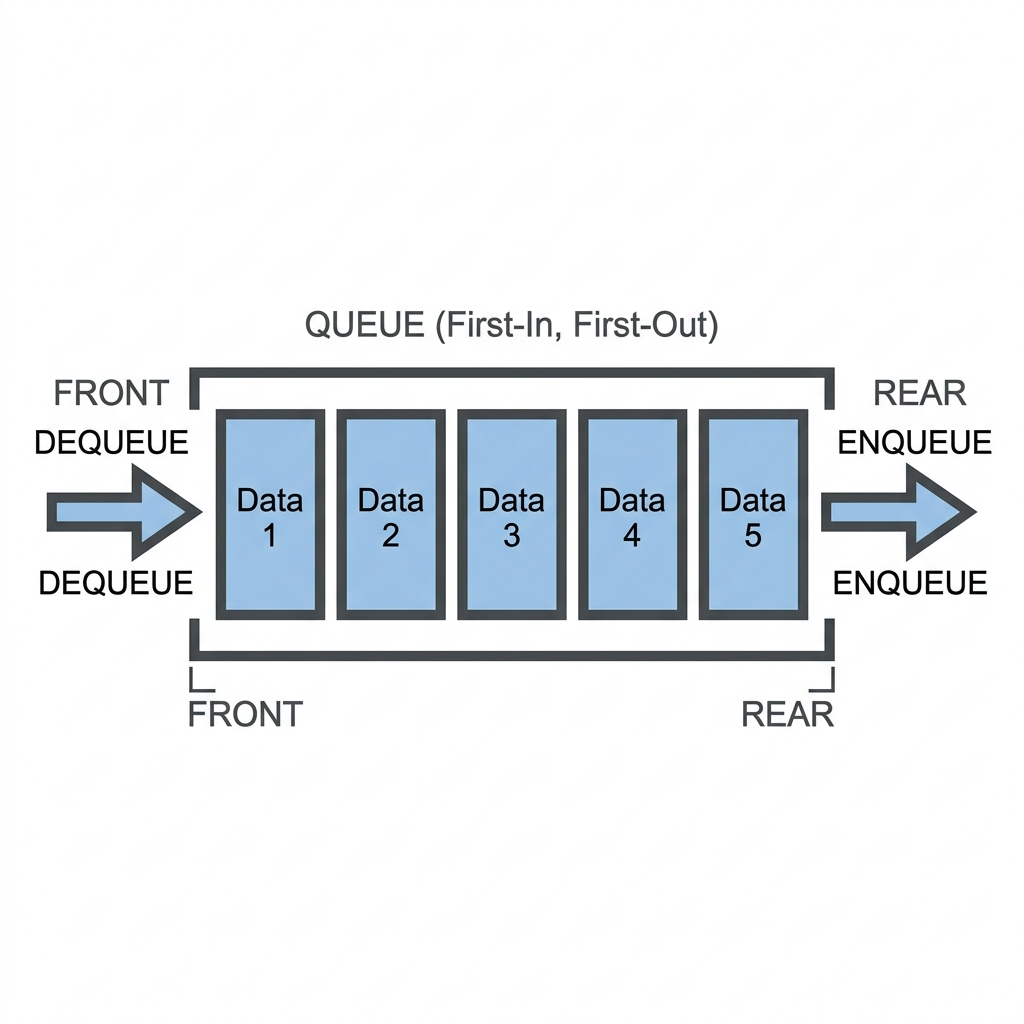
A queue is a linear data structure that follows the First-In, First-Out (FIFO) principle. (Queue เป็นโครงสร้างข้อมูลเชิงเส้นที่ทำงานตามหลักการ First-In, First-Out (FIFO))
Common Operations:
enqueue(element): Adds an element to the rear of the queue. (เพิ่มองค์ประกอบที่ด้านหลังของคิว)dequeue(): Removes and returns the front element of the queue. (ลบและคืนค่าองค์ประกอบด้านหน้าของคิว)peek(): Returns the front element of the queue without removing it. (คืนค่าองค์ประกอบด้านหน้าของคิวโดยไม่ลบออก)isEmpty(): Checks if the queue is empty. (ตรวจสอบว่าคิวว่างเปล่าหรือไม่)Implementation:
Complexity (for both array and linked list implementations):
Linear search is a simple search algorithm that sequentially checks each element of a list until a match is found or the whole list has been searched. (Linear search เป็นอัลกอริทึมการค้นหาอย่างง่ายที่ตรวจสอบแต่ละองค์ประกอบของรายการตามลำดับจนกว่าจะพบรายการที่ตรงกันหรือค้นหารายการทั้งหมดแล้ว)
Complexity:
Binary search is an efficient algorithm for finding an item from a sorted list of items. It works by repeatedly dividing in half the portion of the list that could contain the item, until you've narrowed down the possible locations to just one. (Binary search เป็นอัลกอริทึมที่มีประสิทธิภาพในการค้นหารายการจากรายการที่ เรียงลำดับแล้ว โดยจะทำงานโดยการแบ่งครึ่งส่วนของรายการที่อาจมีรายการนั้นซ้ำ ๆ จนกว่าคุณจะจำกัดตำแหน่งที่เป็นไปได้ให้เหลือเพียงตำแหน่งเดียว)
Complexity:
A hash table is a data structure that implements an associative array abstract data type, a structure that can map keys to values. A hash table uses a hash function to compute an index into an array of buckets or slots, from which the desired value can be found. (Hash table เป็นโครงสร้างข้อมูลที่ implement ชนิดข้อมูลนามธรรมของอาร์เรย์ที่เชื่อมโยง ซึ่งเป็นโครงสร้างที่สามารถจับคู่คีย์กับค่าได้ Hash table ใช้ฟังก์ชันแฮชเพื่อคำนวณดัชนีลงในอาร์เรย์ของบักเก็ตหรือสล็อต ซึ่งสามารถค้นหาค่าที่ต้องการได้)
Key        Hash fn      Index   Buckets (Separate Chaining)
"apple"  ──► h(k) = 2 ──► [2]: "apple" → null
"banana" ──► h(k) = 4 ──► [4]: "banana" → null
"cherry" ──► h(k) = 2 ──► [2]: "apple" → "cherry" → null  ← collision!

[0]: null
[1]: null
[2]: "apple" → "cherry"
[3]: null
[4]: "banana"
[5]: null
Collision Handling:
Complexity:
Recursion is a method of solving a problem where the solution depends on solutions to smaller instances of the same problem. (Recursion เป็นวิธีการแก้ปัญหาที่วิธีแก้ปัญหาขึ้นอยู่กับวิธีแก้ปัญหาของอินสแตนซ์ที่เล็กกว่าของปัญหาเดียวกัน)
Key Concepts:
Example: Factorial
Stack Overflow: If the base case is not reached or the recursion is too deep, it can lead to a stack overflow error. (หากไม่ถึงกรณีพื้นฐานหรือการเรียกซ้ำลึกเกินไป อาจทำให้เกิดข้อผิดพลาด stack overflow)
Insertion sort is a simple sorting algorithm that builds the final sorted array one item at a time. It is much less efficient on large lists than more advanced algorithms such as quicksort, heapsort, or merge sort. (Insertion sort เป็นอัลกอริทึมการเรียงลำดับอย่างง่ายที่สร้างอาร์เรย์ที่เรียงลำดับแล้วทีละรายการ มันมีประสิทธิภาพน้อยกว่ามากในรายการขนาดใหญ่เมื่อเทียบกับอัลกอริทึมขั้นสูงเช่น quicksort, heapsort หรือ merge sort)
Complexity:
Selection sort is an in-place comparison sorting algorithm. It has an O(n^2) time complexity, which makes it inefficient on large lists, and generally performs worse than the similar insertion sort. (Selection sort เป็นอัลกอริทึมการเรียงลำดับแบบเปรียบเทียบในพื้นที่ มีความซับซ้อนด้านเวลา O(n^2) ซึ่งทำให้ไม่มีประสิทธิภาพในรายการขนาดใหญ่ และโดยทั่วไปแล้วจะมีประสิทธิภาพต่ำกว่า insertion sort ที่คล้ายกัน)
Complexity:
Bubble sort is a simple sorting algorithm that repeatedly steps through the list, compares adjacent elements and swaps them if they are in the wrong order. (Bubble sort เป็นอัลกอริทึมการเรียงลำดับอย่างง่ายที่วนซ้ำผ่านรายการ เปรียบเทียบองค์ประกอบที่อยู่ติดกันและสลับตำแหน่งหากเรียงลำดับผิด)
Complexity:
Quicksort is an efficient, in-place sorting algorithm. It works by selecting a 'pivot' element from the array and partitioning the other elements into two sub-arrays, according to whether they are less than or greater than the pivot. The sub-arrays are then sorted recursively. (Quicksort เป็นอัลกอริทึมการเรียงลำดับในพื้นที่ที่มีประสิทธิภาพ ทำงานโดยการเลือกองค์ประกอบ 'pivot' จากอาร์เรย์และแบ่งองค์ประกอบอื่น ๆ ออกเป็นสองอาร์เรย์ย่อย ตามว่าน้อยกว่าหรือมากกว่า pivot จากนั้นอาร์เรย์ย่อยจะถูกเรียงลำดับแบบเรียกซ้ำ)
Complexity:
Merge sort is an efficient, stable, comparison-based sorting algorithm. Most implementations produce a stable sort, which means that the order of equal elements is the same in the input and output. (Merge sort เป็นอัลกอริทึมการเรียงลำดับแบบเปรียบเทียบที่มีประสิทธิภาพและเสถียร การ implement ส่วนใหญ่จะให้การเรียงลำดับที่เสถียร ซึ่งหมายความว่าลำดับขององค์ประกอบที่เท่ากันจะเหมือนกันในอินพุตและเอาต์พุต)
Complexity:
Counting sort is a sorting algorithm that sorts the elements of an array by counting the number of occurrences of each unique element in the array. It is only efficient if the range of input data is not significantly greater than the number of objects to be sorted. (Counting sort เป็นอัลกอริทึมการเรียงลำดับที่เรียงลำดับองค์ประกอบของอาร์เรย์โดยการนับจำนวนการปรากฏของแต่ละองค์ประกอบที่ไม่ซ้ำกันในอาร์เรย์ จะมีประสิทธิภาพก็ต่อเมื่อช่วงของข้อมูลอินพุตไม่มากกว่าจำนวนอ็อบเจกต์ที่จะเรียงลำดับอย่างมีนัยสำคัญ)
Complexity:
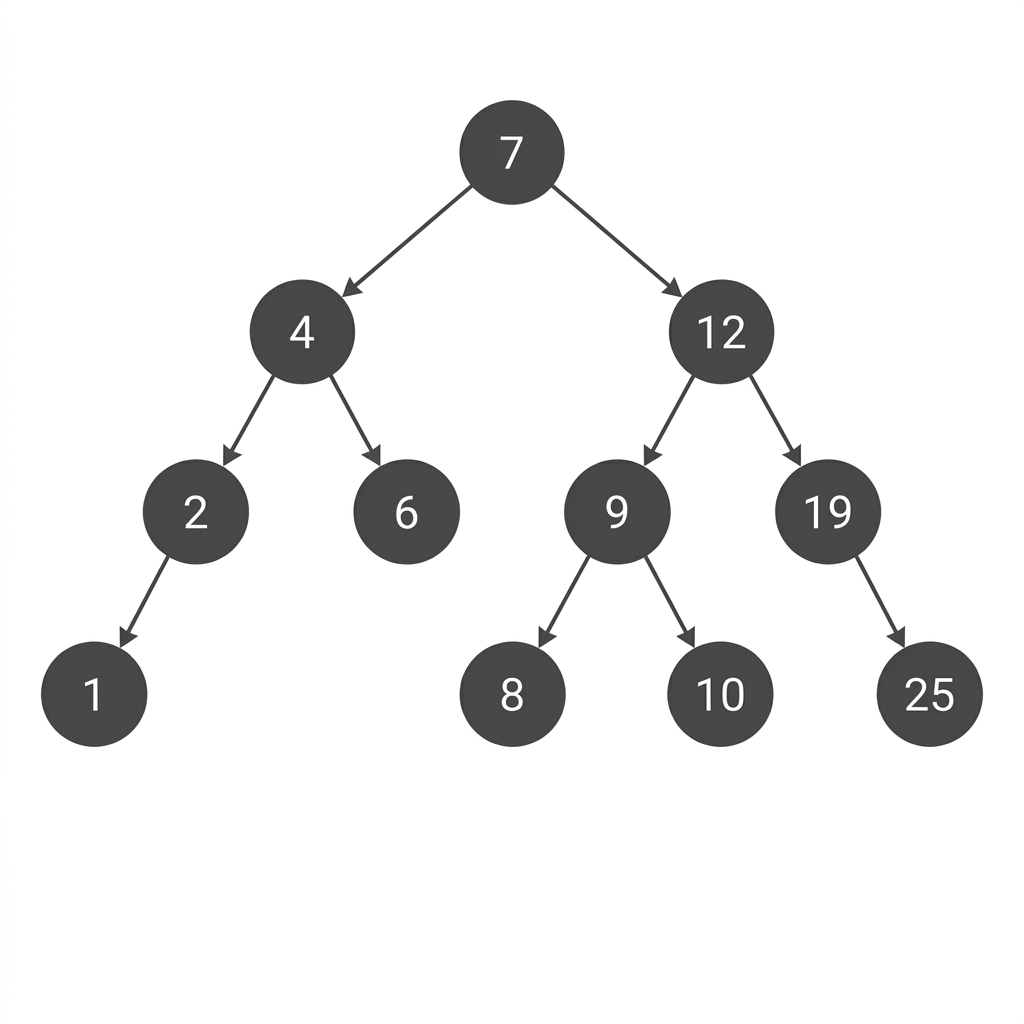
A tree is a hierarchical data structure that consists of nodes connected by edges. (Tree เป็นโครงสร้างข้อมูลแบบลำดับชั้นที่ประกอบด้วยโหนดที่เชื่อมต่อกันด้วยขอบ)
              [Root]          ← root node (no parent)
             /      \
          [A]        [B]      ← internal nodes (parent of children below)
         /   \          \
       [C]   [D]        [E]   ← leaf nodes (no children)
A binary search tree is a binary tree in which for each node, all elements in the left subtree are less than the node, and all elements in the right subtree are greater than the node. (Binary search tree เป็น binary tree ที่สำหรับแต่ละโหนด องค์ประกอบทั้งหมดในแผนผังย่อยด้านซ้ายจะน้อยกว่าโหนด และองค์ประกอบทั้งหมดในแผนผังย่อยด้านขวาจะมากกว่าโหนด)
Complexity:
A heap is a specialized tree-based data structure that satisfies the heap property: if P is a parent node of C, then the key (the value) of P is either greater than or equal to (in a max heap) or less than or equal to (in a min heap) the key of C. (Heap เป็นโครงสร้างข้อมูลแบบต้นไม้พิเศษที่สอดคล้องกับคุณสมบัติของฮีป: หาก P เป็นโหนดพาเรนต์ของ C ดังนั้นคีย์ (ค่า) ของ P จะมากกว่าหรือเท่ากับ (ใน max heap) หรือน้อยกว่าหรือเท่ากับ (ใน min heap) คีย์ของ C)
Complexity:
A trie, also called digital tree or prefix tree, is a type of search tree, a tree data structure used for locating specific keys from within a set. (Trie หรือที่เรียกว่า digital tree หรือ prefix tree เป็นประเภทของ search tree ซึ่งเป็นโครงสร้างข้อมูลแบบต้นไม้ที่ใช้สำหรับค้นหาคีย์เฉพาะจากภายในชุด)
        (root)
           │
           c
           │
           a
         / │ \
        t  n   r
       (*)  (*) (*)
      "cat" "can" "car"

(*) = end-of-word marker
A graph is a data structure that consists of a set of vertices (or nodes) and a set of edges that connect these vertices. (กราฟเป็นโครงสร้างข้อมูลที่ประกอบด้วยชุดของจุดยอด (หรือโหนด) และชุดของขอบที่เชื่อมต่อจุดยอดเหล่านี้)
  (A)──────(B)
   │  \      │
   │   \     │
  (C)  (D)──(E)

Vertices: A, B, C, D, E
Edges: A-B, A-C, A-D, B-E, D-E
A disjoint-set data structure is a data structure that keeps track of a set of elements partitioned into a number of disjoint (non-overlapping) subsets. A union-find algorithm is an algorithm that performs two useful operations on such a data structure:
A directed acyclic graph is a directed graph with no directed cycles. (กราฟแบบมีทิศทางที่ไม่มีวงจรแบบมีทิศทาง)
Topological sorting for Directed Acyclic Graph (DAG) is a linear ordering of vertices such that for every directed edge from vertex u to vertex v, u comes before v in the ordering. (การเรียงลำดับเชิงทอพอโลยีสำหรับกราฟแบบมีทิศทางที่ไม่มีวงจร (DAG) คือการเรียงลำดับเชิงเส้นของจุดยอดโดยที่สำหรับทุกขอบแบบมีทิศทางจากจุดยอด u ไปยังจุดยอด v, u จะมาก่อน v ในการเรียงลำดับ)
A minimum spanning tree (MST) or minimum weight spanning tree is a subset of the edges of a connected, edge-weighted undirected graph that connects all the vertices together, without any cycles and with the minimum possible total edge weight. (Minimum spanning tree (MST) หรือ minimum weight spanning tree เป็นเซตย่อยของขอบของกราฟที่ไม่มีทิศทางที่มีน้ำหนักและเชื่อมต่อกัน ซึ่งเชื่อมต่อจุดยอดทั้งหมดเข้าด้วยกัน โดยไม่มีวงจรและมีน้ำหนักขอบรวมน้อยที่สุดเท่าที่จะเป็นไปได้)
Backtracking is a general algorithm for finding all (or some) solutions to some computational problems, notably constraint satisfaction problems, that incrementally builds candidates to the solutions, and abandons a candidate ("backtracks") as soon as it determines that the candidate cannot possibly be completed to a valid solution. (Backtracking เป็นอัลกอริทึมทั่วไปสำหรับการค้นหาคำตอบทั้งหมด (หรือบางส่วน) สำหรับปัญหาเชิงคำนวณบางอย่าง โดยเฉพาะอย่างยิ่งปัญหาความพึงพอใจในข้อจำกัด ซึ่งจะสร้างผู้สมัครสำหรับคำตอบเพิ่มขึ้นเรื่อย ๆ และละทิ้งผู้สมัคร ("ย้อนกลับ") ทันทีที่พิจารณาแล้วว่าผู้สมัครไม่สามารถทำให้สมบูรณ์เป็นคำตอบที่ถูกต้องได้)
Common Problems:
┌───┬───┬───┐    Legend:  S = Start
│ S →   │   │             E = End
├───┼───┼───┤             → = path explored
│   │ ✗ │   │             ✗ = dead end (backtrack)
├───┼───┼───┤             * = correct path
│   │   │ E │
└───┴───┴───┘

Step 1: S → right → dead end ✗  (backtrack to S)
Step 2: S ↓ → ↓ → right → E ✓

Correct path:
┌───┬───┬───┐
│ S │   │   │
├───┼───┼───┤
│ * │ ✗ │   │
├───┼───┼───┤
│ * → * → E │
└───┴───┴───┘
A greedy algorithm is an algorithmic paradigm that follows the problem-solving heuristic of making the locally optimal choice at each stage with the hope of finding a global optimum. (อัลกอริทึมแบบละโมบเป็นกระบวนทัศน์อัลกอริทึมที่ปฏิบัติตามฮิวริสติกการแก้ปัญหาของการเลือกตัวเลือกที่เหมาะสมที่สุดในแต่ละขั้นตอนโดยหวังว่าจะพบค่าที่เหมาะสมที่สุดทั่วโลก)
Common Problems:
Note: Greedy algorithms do not always yield the optimal solution, but for many problems they do. (หมายเหตุ: อัลกอริทึมแบบละโมบไม่ได้รับประกันว่าจะให้ผลลัพธ์ที่ดีที่สุดเสมอไป แต่สำหรับหลาย ๆ ปัญหาก็สามารถทำได้)